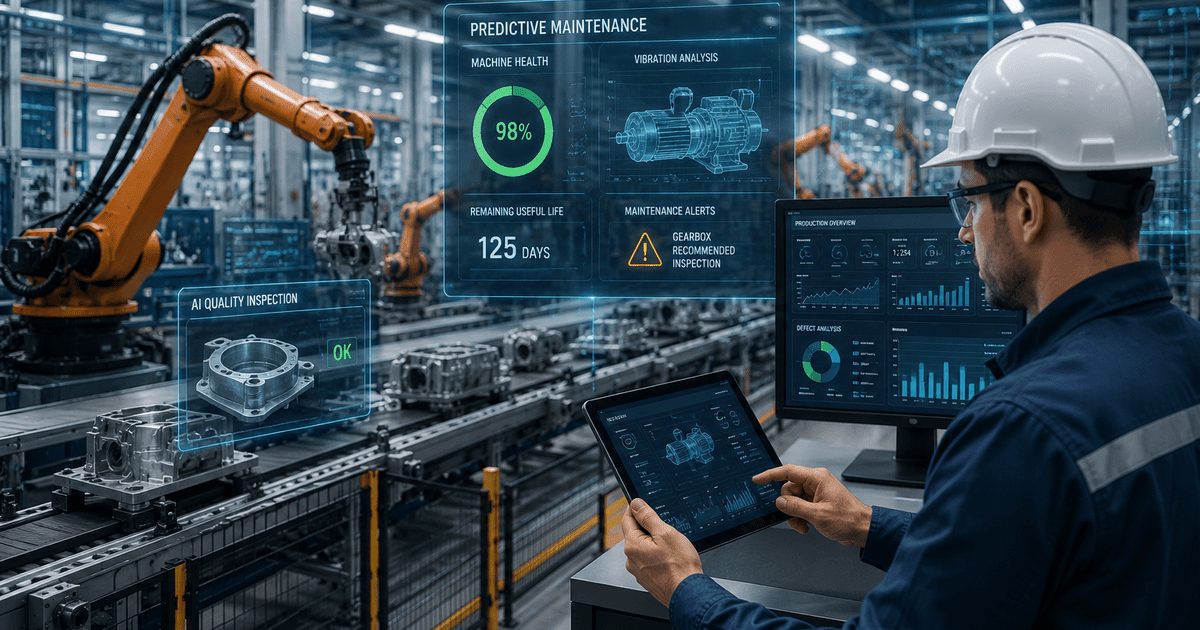
Manufacturing leaders are inundated with Industry 4.0 claims. Every technology vendor promises transformation: connected factories, self-optimizing production lines, AI-powered quality at scale.
Most of it is forward-looking speculation dressed as present reality.
This post is about what is actually working — the specific AI applications in manufacturing that are delivering measurable outcomes today, the data requirements behind them, and how mid-sized manufacturers can prioritize where to start without building a dedicated data science team first.
The two use cases with the strongest documented ROI and the most accessible implementation path are quality control and predictive maintenance. This post covers both in depth.
Quick Navigation
- What is AI in manufacturing?
- Use Case 1: Predictive Maintenance
- Use Case 2: AI-Powered Quality Control
- Data Requirements for Both Use Cases
- Where to Start: Prioritization Framework
- Common Concerns from Manufacturing Leaders
- Key Takeaways
What is AI in Manufacturing?
AI in manufacturing refers to the application of machine learning models, predictive analytics, computer vision, and automation systems to improve production efficiency, reduce quality defects, prevent equipment failures, and optimize operational decisions.
Unlike general-purpose AI tools designed for office environments, manufacturing AI works with operational technology (OT) data — sensor readings, machine logs, quality inspection records, production schedules, and maintenance histories. The goal is to convert that data, which most manufacturers are already generating, into operational decisions that previously required experienced engineers to make manually.
The two categories that consistently deliver the strongest ROI without requiring a factory-wide technology overhaul are:
- Predictive maintenance — using sensor data and maintenance history to predict equipment failures before they cause downtime
- Quality control — using inspection data, process parameters, and vision systems to detect defects earlier in the production cycle
Both are achievable with existing operational data. Neither requires replacing existing equipment or rebuilding production line control systems.
Use Case 1: Predictive Maintenance
What Is Predictive Maintenance AI?
Predictive maintenance AI is a machine learning system that analyzes equipment sensor data — vibration, temperature, pressure, cycle counts, current draw, and other operational parameters — to identify patterns that precede equipment failure. When the system detects a pattern associated with elevated failure risk, it alerts the maintenance team before the failure occurs.
The distinction from scheduled maintenance is significant:
| Maintenance Approach | How It Works | Key Problem |
|---|---|---|
| Reactive (breakdown) | Fix equipment after it fails | Unplanned downtime, emergency repair costs, scrapped production |
| Scheduled (time-based) | Maintain equipment on a fixed calendar regardless of condition | Over-maintenance of healthy equipment, under-maintenance of stressed equipment |
| Predictive (condition-based) | Maintain equipment when data indicates elevated failure risk | Requires sensor data and a trained model |
Scheduled maintenance is the current standard at most mid-sized manufacturers. It is better than reactive maintenance, but it has a fundamental inefficiency: the maintenance calendar does not know which piece of equipment is actually stressed.
A motor that runs at 40 percent load does not need the same maintenance interval as the same model motor running at 90 percent load. Scheduled maintenance treats them identically. Predictive maintenance does not.
What the Data Shows
Documented outcomes from predictive maintenance implementations across manufacturing sectors:
| Metric | Typical Improvement |
|---|---|
| Unplanned downtime reduction | 30–65% |
| Maintenance cost reduction | 10–25% |
| Equipment lifespan extension | 15–30% |
| False alarm rate (compared to threshold-based alerts) | 50–70% reduction |
| Time to detect failure precursor | 24–72 hours advance warning vs. 0–4 hours with threshold alerts |
Sources: McKinsey Global Institute Manufacturing AI Report; Deloitte Industry 4.0 Insights; Siemens operational case data.
The 24 to 72 hour advance warning is the critical output. A maintenance team with 48 hours of notice can schedule the repair during a planned production break, source the required part, and assign the right technician. An unplanned failure at 2 AM requires emergency parts procurement, overtime rates, and however long it takes to diagnose the failure from scratch.
How Predictive Maintenance AI Is Implemented
Step 1 — Sensor data collection and storage
Most modern industrial equipment already has sensors. The question is whether that data is being captured and stored in a retrievable format. PLC logs, SCADA historian systems, and equipment monitoring platforms typically contain 6 to 24 months of historical data. If it exists, it is the foundation of the model.
Step 2 — Maintenance history correlation
The model needs to know what the sensor data looked like before documented failures. Historical maintenance records — even spreadsheet-based ones — provide the labeled examples: “on this date, this equipment failed with this mode of failure, and the sensor readings in the 72 hours prior looked like this.”
Step 3 — Model training and validation
A machine learning model is trained on the paired data: sensor readings over time, correlated with maintenance events and failure modes. The model learns which sensor patterns precede which failure types, at what lead time.
Step 4 — Alert system deployment
The trained model monitors live sensor data and generates alerts when it detects patterns associated with elevated failure risk. Alerts are sent to the maintenance team with the specific equipment ID, the predicted failure mode, the confidence level, and the estimated time window.
Step 5 — Model improvement over time
Maintenance team feedback on each alert (Was this accurate? What did they find?) improves the model continuously. False positive rates decrease over time as the model refines its thresholds.
Data Requirements for Predictive Maintenance
Minimum requirements for a viable pilot:
– 12 months of sensor data for the targeted equipment
– At least 10 to 15 documented failure events for the targeted equipment type (for model training)
– Sensor sampling frequency of at least 1 reading per 15 minutes (higher frequency improves model sensitivity)
– Maintenance records that can be correlated to the sensor data by date
Equipment types where predictive maintenance consistently delivers strong results:
– CNC machines (spindle bearings, coolant systems)
– Compressors and HVAC units (vibration, temperature)
– Conveyors and material handling equipment (motor current, belt tension)
– Pumps (vibration, flow rate, pressure differential)
– Industrial motors (current signature analysis, temperature)
Use Case 2: AI-Powered Quality Control
What Is AI Quality Control in Manufacturing?
AI quality control in manufacturing uses machine learning models to detect product defects earlier in the production process — reducing the cost of escaping defects, improving yield, and reducing reliance on manual inspection for high-volume production.
There are two primary implementation approaches:
Computer Vision Inspection
Cameras capture images of products at specific points in the production process. A trained vision model analyzes each image and classifies the product as conforming or defective, and identifies the defect type and location. The system operates at line speed, does not fatigue, and provides consistent classification criteria on every unit.
Process Parameter Correlation
Machine learning models analyze the relationships between upstream process parameters (temperature, pressure, speed, material batch characteristics) and downstream quality outcomes. The model identifies which parameter combinations produce defects, enabling process adjustments before defective units are produced.
Both approaches have different cost profiles and data requirements. Vision systems require camera hardware and image labeling work. Process parameter models work with data most manufacturers are already collecting.
What the Data Shows
| Metric | Typical Improvement |
|---|---|
| Defect detection rate | 85–99% (vs. 65–80% for manual inspection on high-volume lines) |
| Inspection throughput | 3–10x manual inspection speed |
| Escaping defect reduction | 40–70% |
| Inspection labor cost reduction | 30–60% |
| Scrap rate reduction (with process parameter model) | 15–40% |
The escaping defect reduction is the highest-value outcome. An escaping defect — a defective product that reaches a customer — generates warranty claims, return shipping costs, customer relationship damage, and potential regulatory exposure depending on the industry. Preventing one escaping defect in medical devices or aerospace components is worth substantially more than preventing the same defect in consumer goods. The ROI calculation varies accordingly.
How AI Quality Control Is Implemented
Vision-Based Inspection (for visible surface defects)
Vision systems are appropriate when:
– Defects are visually detectable (surface cracks, dimensional variation, color deviation, contamination, missing components)
– Production volume is high enough that manual inspection creates a bottleneck or fatigue-related inconsistency
– Inspection criteria are well-defined and can be captured in labeled image examples
Implementation path:
1. Camera system installation at the inspection point
2. Image capture of 500 to 2,000 labeled examples (conforming and defective, with defect type annotations)
3. Model training and validation on the labeled dataset
4. Pilot deployment at a single inspection point
5. Performance tuning based on production feedback
Process Parameter Correlation (for process-driven defects)
Process parameter models are appropriate when:
– Defects are driven by upstream process variation (not random contamination or assembly error)
– Process parameters are already being logged (even in basic form)
– The same process parameters produce inconsistent quality across batches
Implementation path:
1. Audit of existing process parameter data and quality inspection records
2. Correlation analysis to identify the parameters most associated with quality outcomes
3. Model training on historical parameter-outcome pairs
4. Dashboard deployment showing real-time parameter status and predicted quality risk
5. Alert system for parameter combinations that predict elevated defect risk
A Worked Example: Injection Molding Quality Control
An injection molding manufacturer produces 15,000 parts per day across three production lines. Manual visual inspection catches approximately 70 percent of surface defects. The escaping 30 percent generates $85,000 per year in warranty claims and return handling.
Existing data available:
– 18 months of cycle-by-cycle process parameter logs (injection pressure, temperature, cooling time, cycle time)
– Quality inspection records noting defect types and rates by shift
– 3,200 archived product images with defect/conforming classifications
Implementation approach:
Phase 1 — Process parameter model using historical data (8 weeks, no hardware required)
Phase 2 — Vision inspection on the highest-volume line (12 weeks, camera hardware required)
Projected outcomes after Phase 1:
– Defect rate reduction: 25 to 35% from process parameter optimization alone
– Scrap material savings: $18,000 to $24,000 per year
Projected outcomes after Phase 2:
– Defect detection rate: 92 to 96% (up from 70%)
– Escaping defect reduction: 60% → $51,000 per year in warranty cost reduction
– Inspection labor: 1 FTE reallocated from visual inspection to process monitoring
Implementation investment: $65,000 (both phases)
Annual benefit: $69,000 to $75,000
Payback period: ~10 months
Data Requirements Summary
| Use Case | Minimum Historical Data | Minimum Event Data | Hardware Required |
|---|---|---|---|
| Predictive Maintenance | 12 months sensor data | 10–15 failure events | None (uses existing sensors) |
| Process Parameter Quality | 12 months parameter logs | 500+ quality records | None |
| Vision Inspection | 500+ labeled images | N/A | Cameras + lighting |
Most mid-sized manufacturers can run a predictive maintenance pilot or process parameter quality pilot without any hardware investment — using only the data their existing systems are already capturing.
Where to Start: A Prioritization Framework
Given limited time and budget, the correct question is not “which AI use case sounds most interesting?” It is “which use case has the strongest business case given our specific situation?”
Score each potential use case on these five factors:
| Factor | Weight | Questions to Answer |
|---|---|---|
| Business impact of current problem | 30% | What does unplanned downtime/defect escapes cost per year? |
| Data availability | 25% | Do we have 12+ months of relevant operational data? |
| Process definition | 20% | Is the process well-enough defined to train a model against? |
| Implementation complexity | 15% | Are the relevant systems accessible and documented? |
| Team readiness | 10% | Is there an internal champion and operational buy-in? |
For most mid-sized manufacturers, the recommended starting sequence:
- Predictive maintenance on your highest-criticality equipment — highest downtime cost, existing sensor data, no hardware investment required
- Process parameter quality model — if scrap rates or warranty costs are a documented problem and process data exists
- Vision inspection — only after the first two use cases have established AI as a credible tool internally and provided implementation learnings
Starting with vision inspection first — which many vendors push because it is visually impressive — often leads to the longest implementation timelines and highest upfront costs. Start with data-first approaches that leverage what you already have.
Common Concerns from Manufacturing Leaders
“Our equipment is old and does not have sensors.”
Many older industrial machines can be retrofitted with low-cost vibration and temperature sensors that communicate wirelessly. A retrofit program for 5 to 10 critical machines typically costs $5,000 to $15,000 in hardware — far less than the cost of one major unplanned failure on a critical production asset.
If even basic retrofitting is not feasible, process parameter data from manual logs, quality records, and production reports can still support a meaningful model. The sensor data path is faster and more accurate, but it is not the only path.
“We have the data but it is in spreadsheets and paper logs.”
Paper and spreadsheet data can be used, but requires a data preparation phase before model training. Depending on the volume and consistency of records, this preparation takes 2 to 6 weeks. The effort is worth it if the resulting dataset covers 12+ months and includes enough failure or defect events to train against.
Paper logs should be digitized going forward regardless of any AI initiative — the operational visibility improvement alone justifies the effort.
“We are concerned about connecting production systems to cloud platforms.”
This is a legitimate concern in manufacturing environments with strict OT/IT separation requirements. The standard solution is an on-premises or private cloud deployment where the AI model runs on your infrastructure, not on a shared cloud environment. Sensor data never leaves your network. This is a more complex deployment but is well-established for regulated manufacturing environments.
“How do we manage the change with our maintenance team?”
The maintenance teams that embrace predictive maintenance fastest are the ones that understand it as a tool for them, not a replacement of their expertise. The AI model tells maintenance engineers where to look and when. The maintenance engineers decide what to do and how.
Experienced maintenance technicians are typically enthusiastic about predictive maintenance because it validates what they already know intuitively about the machines they have maintained for years — and gives them the lead time they need to do the job properly instead of responding to crises.
Key Takeaways
-
Predictive maintenance and quality control are the highest-ROI AI applications in manufacturing today. Both are accessible to mid-sized manufacturers using existing operational data.
-
The data foundation is usually already there. 12+ months of sensor data or process logs, combined with maintenance records or quality inspection data, is sufficient for a viable pilot.
-
No hardware investment is required for the first phase. Predictive maintenance pilots and process parameter quality models work entirely with existing data. Hardware investment comes in Phase 2 if justified by Phase 1 results.
-
Advance warning is the critical output of predictive maintenance. 24 to 72 hours of notice before a failure converts an emergency repair into a planned maintenance event — with all the cost and quality implications that difference carries.
-
Start with your highest-criticality equipment. The business case is strongest where unplanned downtime costs the most. Build the ROI case on that equipment, demonstrate results, and expand.
-
Involve the maintenance and quality teams in design. Their knowledge of failure modes, process variations, and inspection nuances directly improves model performance. Their buy-in directly improves adoption.
-
Phase the implementation. Data-first approaches (predictive maintenance, process parameters) before hardware-dependent approaches (vision inspection). Learn before you invest in physical infrastructure.
Are your maintenance or quality costs a documented operational problem?
We work with manufacturers to identify whether existing sensor and process data can support a predictive maintenance or quality control pilot — typically within a 30-minute conversation.
If the data supports it, we can scope and price a contained pilot in 5 business days.
Book a free operational assessment at cybernamix.ai/contact-us/
Cybernamix AI builds intelligent automation and data science solutions for manufacturing, logistics, healthcare, e-commerce, and financial services. Based in Mississauga, Ontario. AI and Data Science services | Advanced Analytics | Consulting