Client: Dynamic Logistics (name anonymized) — a Canadian logistics company with 200+ employees serving customers across North America.
Industry: Logistics and Freight
Service Deployed: Cybernamix Customer Support AI Agent
Timeline: 8 weeks from discovery to live
This AI customer support case study in logistics documents exactly what happened when a Canadian freight company deployed Cybernamix AI alongside their existing 12-person support team. No layoffs. No organizational upheaval. Just measurable results in under 90 days.
Headline Results After 90 Days
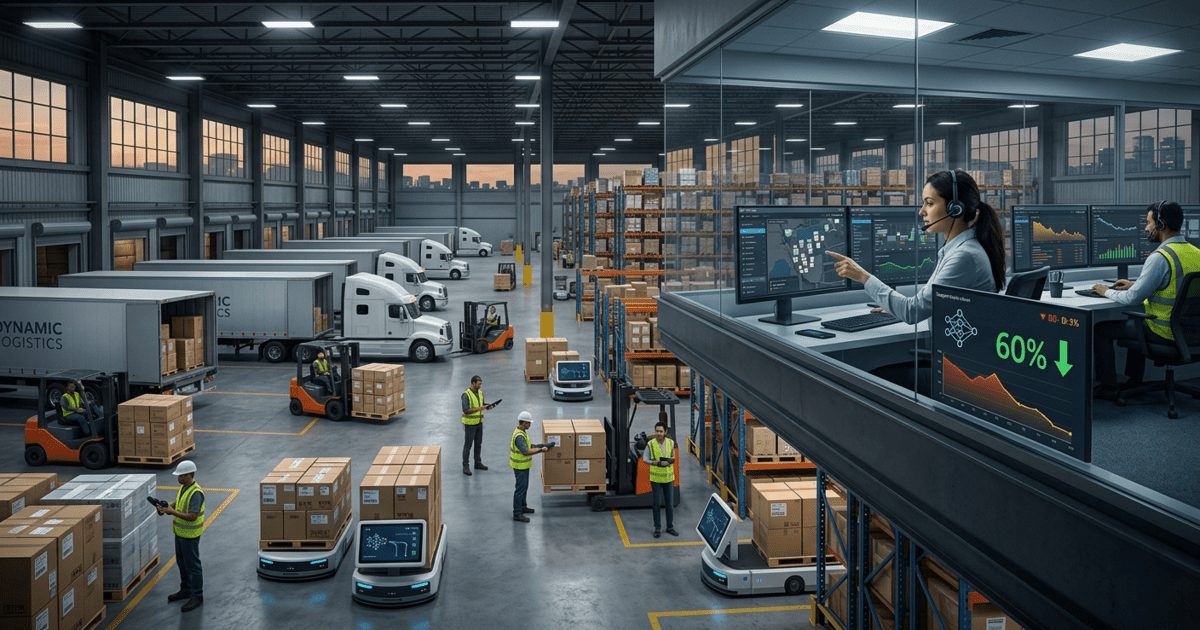
- 60% reduction in weekly support ticket volume for the human team
- 81% faster average response time (4.2 hours → 47 minutes)
- 22% higher customer satisfaction (CSAT 3.6 → 4.4)
- Zero jobs cut — same 12-person team, more impactful work
The Challenge: A Support Team Drowning in Repetitive Tickets
Dynamic Logistics came to Cybernamix with a familiar problem. Their support team was stretched to breaking. Weekly ticket volume had climbed past 800, and the 12-person team could not keep up.
The root cause was not complexity — it was repetition. A breakdown of three months of ticket data showed:
- 35% of tickets — shipment tracking questions (“where is my order?”)
- 25% of tickets — delivery update requests (“when will it arrive?”)
- 15% of tickets — billing questions (invoice clarifications, payment status)
- 25% of tickets — everything else (claims, escalations, special requests)
The first 75% of their ticket volume was the same handful of questions being answered hundreds of times per week. Meanwhile, response time had drifted to 4.2 hours on average. Customer satisfaction sat at 3.6 out of 5 — not bad, not great, and trending down.
The support manager described the situation this way: “My team came in every Monday already behind. They ended every Friday more behind. We were running a marathon at sprint pace, and nobody was winning.”
Traditional solutions did not fit:
- Hiring more people — expensive, slow, and did not solve the underlying repetition problem
- Outsourcing — would lose the deep logistics expertise the team had built up
- Basic chatbots — tried before, failed. Customers hated them, agents had to clean up the mess
Dynamic Logistics needed something smarter — AI that could handle the repetitive 75% while preserving the team’s expertise for the complex 25%.
The Cybernamix Approach: Augment, Not Replace
The Cybernamix philosophy is simple: AI should empower teams, not replace them. That philosophy shaped every decision in the Dynamic Logistics deployment.
Weeks 1-2: Discovery and Data Audit
The Cybernamix team spent two weeks analyzing three months of Dynamic Logistics ticket data. Every question type. Every resolution path. Every edge case. By the end of week two, we had mapped the top 40 ticket patterns and identified which 75% could be handled autonomously by AI.
Weeks 3-4: Design and Setup
The Customer Support AI Agent was configured and connected to:
- Dynamic Logistics’ existing helpdesk system (Zendesk)
- Their shipping data platform (for real-time tracking lookups)
- Their billing system (for invoice and payment queries)
- Their customer database (for personalized responses)
The AI was trained on 18 months of resolved ticket responses — learning not just the answers, but the company’s tone, their specific logistics terminology, and how they handled edge cases.
Weeks 5-6: Assisted Mode
The AI went live in “assisted mode.” Every AI-drafted response was reviewed by a human agent before going to the customer. The team caught edge cases, refined responses, and built confidence in the AI’s capabilities.
By the end of week 6, the team was approving 92% of AI drafts without changes. The remaining 8% flagged genuine edge cases that taught the AI how to handle variations.
Weeks 7-8: Autonomous Mode
The AI transitioned to autonomous handling for high-confidence ticket categories — shipment tracking, standard delivery updates, and common billing questions. Human agents handled the escalations, complex claims, and new-pattern cases that required judgment.
The Results: Measured Against Real Business Metrics
After 90 days of live operation, here is what Dynamic Logistics measured:
| Metric | Before AI | After AI (90 Days) | Change |
|---|---|---|---|
| Weekly ticket volume (human team) | 800+ | ~320 | -60% |
| Average response time | 4.2 hours | 47 minutes | -81% |
| First-response resolution rate | 34% | 71% | +109% |
| Customer satisfaction (CSAT) | 3.6/5 | 4.4/5 | +22% |
| Agent burnout reports | Frequent | Rare | Significant drop |
| Time to ROI | — | 90 days | Payback achieved |
| Jobs cut | — | 0 | Same 12-person team |
The shift in what the human team spent their time on was equally important. Before AI, 75% of their time went to answering the same handful of repetitive questions. After AI, 80% of their time went to complex escalations, key account management, and process improvements that further reduced ticket volume across the board.
“My team went from surviving to actually improving things. That is the difference.”
— Support Manager, Dynamic Logistics
What Made This Deployment Work
Not every AI deployment delivers these results. Here is what was different about this one:
- Narrow scope at launch. We did not try to automate everything at once. We started with the three highest-volume ticket categories and proved value before expanding.
- Deep integration. The AI was connected to real shipping data, real billing systems, and real customer records. It was not a generic chatbot — it was a logistics-specific agent with actual context.
- Human review during ramp-up. The assisted mode weeks built team trust and caught edge cases before they became customer-facing errors.
- No layoff agenda. The team knew from day one that their jobs were not at risk. That turned potential resistance into active partnership.
- Clear success metrics. We knew exactly what “good” looked like before deployment. Weekly ticket volume. Response time. CSAT. Everything was measurable from day one.
What Is Next for Dynamic Logistics
With the customer support AI running smoothly, Dynamic Logistics is expanding its use of Cybernamix AI into two new areas:
- Research AI Agent — to automate competitive analysis, rate shopping, and industry intelligence for their sales team
- Task-Specific AI Agents — to automate internal workflows around claims processing and documentation
The support team that initially worried about AI has become the internal champions. They know where automation helps, where it does not, and they are helping identify the next workflows to tackle. This is how AI adoption is supposed to work — employees guiding expansion based on what they have seen with their own eyes.
Key Takeaways
- AI can eliminate 60% of repetitive ticket volume without eliminating any jobs.
- Response time improvements of 80%+ are realistic when AI is deeply integrated with your data — not a surface-level chatbot.
- Customer satisfaction typically rises, not falls, when AI handles volume and humans handle complexity.
- A 90-day deployment timeline from discovery to full autonomy is achievable with focused scope.
- The biggest ROI is what the human team does with their freed-up time — process improvements, key account work, proactive outreach.
For a deeper look at the five specific mechanisms AI uses to achieve these results, see our guide on how AI customer support agents reduce response time by 80%.
Running a logistics, freight, or transportation operation with a support team drowning in repetitive tickets? Book a free AI support assessment — we will analyze your actual ticket data and show you exactly what a Cybernamix deployment would look like for your business. 30 minutes, no sales pitch, practical numbers.